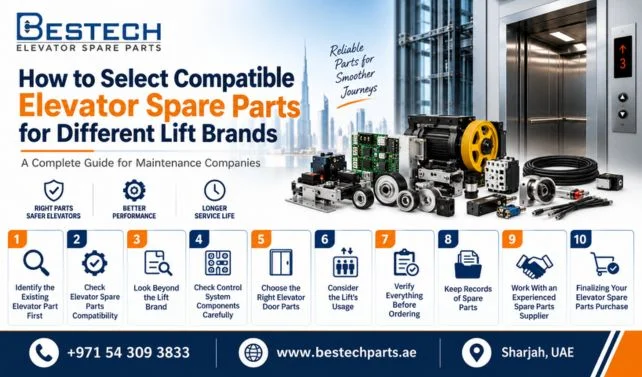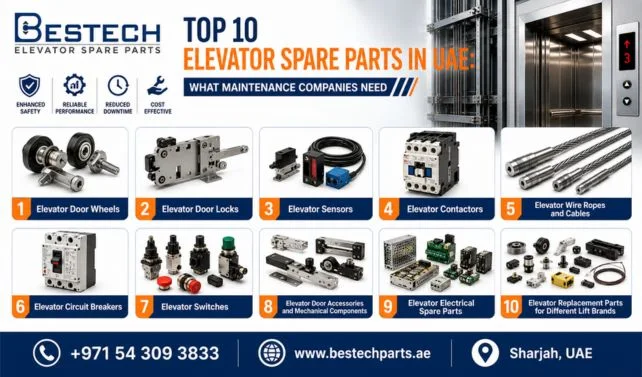
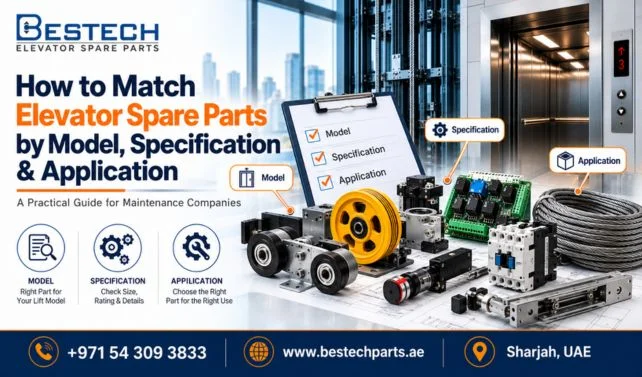
When an elevator needs a replacement component, finding something that looks similar is not enough. A spare part may have a different voltage, size, connection, mounting arrangement or operating range. These differences can affect whether it fits the equipment and performs as expected.
Checking elevator spare parts compatibility before ordering helps maintenance teams and buyers avoid choosing the wrong replacement. Instead of searching by appearance alone, start with the information available on the existing part and compare it with the requirements of the elevator system.
Why Correct Spare Part Matching Is Important
An unsuitable component can create installation problems, unexpected downtime or repeated replacement costs. Electrical parts with the wrong voltage or current rating may not suit the circuit. Mechanical parts can also differ in dimensions or mounting points even when two products look almost identical.
The elevator brand or system name is only a starting point. The individual component has its own identification details and technical requirements.
Compatibility should not be confirmed from appearance alone. Two components can have similar housings or dimensions while differing in voltage, current rating, connections, interface, mounting arrangement or intended application. For this reason, the original part reference and technical specifications should be checked before selecting a replacement.
How to Identify Elevator Spare Parts
The existing component is usually the best place to begin. Before contacting a supplier, collect as much information as possible:
- Elevator brand and model
- Component name
- Part or model number
- Manufacturer or OEM number
- Voltage and current rating
- Frequency and power rating
- Dimensions
- Mounting arrangement
- Application or installation location
- Clear photographs of the component and label
A clear photo can reveal information that is difficult to describe in a message. If the component has a nameplate or specification sticker, photograph the entire label.
Check the Elevator Spare Parts Model Number
The elevator spare parts model number may be printed on a label, sticker, nameplate or directly on the component. Electrical products often display the identification number alongside voltage, current or other technical information.
One common mistake is confusing the elevator model number with the spare-part number. The elevator model identifies the overall equipment, while the part number identifies a particular component.
If several numbers are printed on the part, record all of them. This helps distinguish a product code, series number or revision number.
Check Lift Spare Parts Specifications
The technical details required depend on the component and its application. Matching only one specification, such as voltage or dimensions, does not necessarily confirm compatibility.
Electrical spare parts may require checks such as:
- Voltage and current rating
- Frequency
- Power rating
- Coil voltage, where applicable
- Contact configuration
- Connection or interface type
- Mounting requirements
Mechanical spare parts may require:
- Overall dimensions
- Material
- Mounting arrangement
- Shaft or connection dimensions, where applicable
- Load or operating requirements
- Intended application
The specifications that matter depend on the component. A contactor, encoder, inverter and door lock should not be checked using the same compatibility criteria. The replacement should be compared with the existing part's identification details, technical specifications and application before ordering.
Match the Spare Part to Its Application
Contactors are commonly used for switching electrical loads and control circuits. Circuit breakers are selected for electrical protection. Inverters are used for motor drive and speed control. Sensors can be installed for door, position or safety-related functions.
Encoders provide speed or position feedback, while door motors and door drives are used for automatic door movement. Door locks have their own mechanical and electrical requirements.
The component's location and function should therefore be included when requesting a replacement. A general product category does not always identify the exact version required.
For control-related needs, it is useful to review elevator control system spare parts, such as buttons, sensors, inverters and other control components.
Electrical vs Mechanical Spare Parts: What Should You Check?
| Part Type | Information to Check | Why It Matters |
|---|---|---|
| Inverter | Input/output voltage, power rating, motor requirements and applicable interface | The replacement needs to suit the motor and control requirements |
| Contactor | Coil voltage, current rating and contact arrangement | These determine whether the contactor suits the control circuit and load |
| Circuit breaker | Current rating, poles and voltage | The electrical protection requirements must match the intended circuit |
| Sensor | Sensor type, sensing range, operating voltage and connection | Different sensing and connection requirements can make similar-looking sensors unsuitable |
| Encoder | Resolution, interface and mounting arrangement | The feedback device must suit the system's feedback requirements |
| Door motor | Voltage, dimensions, mounting and application | Both electrical requirements and physical fit need to be checked |
| Door lock | Type, dimensions, mounting and electrical requirements, where applicable | The replacement needs to match the door system and installation requirements |
The required checks vary by component. A replacement should therefore be assessed against the specifications and application of the existing part rather than selected from the product category alone.
What Information Should You Send to a Spare Parts Supplier?
A detailed request gives a supplier a clearer starting point than a message such as “I need an elevator sensor.” Try to include:
- Elevator model
- Component name
- Part number
- Photo of the existing component
- Photo of the specification label
- Required quantity
- Application or installation location
If the original part is unavailable, photos of the surrounding connection or mounting area can also provide useful context.
Common Mistakes When Ordering Elevator Spare Parts
Several simple shortcuts can create problems during purchasing. Common examples include:
- Selecting a component because it looks similar
- Using only the elevator brand for identification
- Confusing the elevator model with the part number
- Ignoring voltage or current ratings
- Not checking dimensions or mounting points
- Leaving out the component's application
- Sending unclear photographs
- Assuming a compatible part will work without verification
Collecting these details before contacting a supplier makes it easier to check the part and discuss compatibility.
OEM vs Compatible Spare Parts
OEM parts are associated with the original equipment manufacturer, while compatible replacement parts are designed to meet the requirements of a particular system or application.
OEM parts follow the original manufacturer's part reference or specification. When choosing a compatible replacement, check the technical ratings, dimensions, connections, mounting arrangement and intended application against the existing component before ordering.
Finding Elevator Spare Parts in the UAE
For buyers sourcing elevator components in the UAE, working with a supplier that covers different spare parts categories can make product research easier.
An elevator spare parts supplier in the UAE can provide access to different product categories and specifications. Buyers looking for electrical components can also explore an elevator electrical spare parts supplier in Dubai to find components suited to their requirements.
If you are sourcing elevator spare parts in the UAE, Bestech Parts provides access to different elevator component categories, including electrical and control-related components. When requesting a replacement, provide the available elevator model, part number, component photographs and specification details so the required part can be assessed against the information available.
If the identification information is incomplete, share clear photographs of the existing component and its specification label so the relevant details can be reviewed before proceeding with an order.
FAQ
1. How can I identify the correct elevator spare part?
Start with the existing component's part number, specifications, dimensions and application. Clear photographs can also help.
2. Is the elevator model number enough to identify a spare part?
Not always. The elevator model identifies the overall equipment, while the individual component may have its own part number and technical requirements.
3. Why should I check lift spare parts specifications?
Specifications such as voltage, current, dimensions and mounting details help determine whether a component suits the intended installation.
4. Can I choose a spare part based only on appearance?
No. Similar-looking components can have different ratings, connections, dimensions or applications.
5. What should I send to a spare parts supplier?
Provide the elevator model, component name, part number, clear photographs, specification label, quantity and installation location or application.