A technician asks for a “door lock.” That sounds specific enough until you open an elevator parts catalogue.
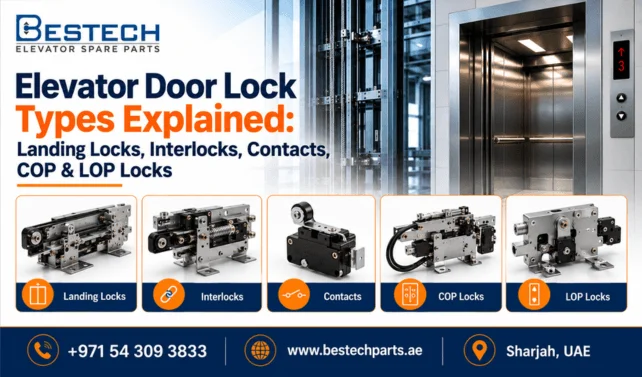
There are landing door locks, interlocks, electrical contacts and key-operated locks for COP and LOP panels. They may all be listed under door-related parts, but each one has a different job.
Understanding the main elevator door lock types makes it easier to identify the right replacement. The location of the part, its function, model number and physical arrangement all matter when matching a replacement.
Landing Door Locks
Start with the door at each floor. When the lift car is away from a floor, the landing door needs to remain securely locked. The locking mechanism fitted to the landing-door assembly provides that mechanical locking function.
The Elevator Landing Door Lock is a mechanical locking mechanism used in lift landing-door assemblies. For a replacement, check the identification on the installed lock first. The model number is particularly helpful, but dimensions, mounting points and the way the lock connects to the door mechanism should also match.
Elevator Door Interlocks
The lift control system needs confirmation that the required door condition has been reached before the car is permitted to travel. An interlock can combine the mechanical locking function with an electrical safety-contact function that provides this confirmation.
The Door Lock Device DK-RN4 is an example of an elevator door interlock. It is installed on the landing door and combines mechanical locking with a safety-contact function.
If a DK-RN4 needs replacing, compare the existing device with the replacement, particularly the connections and locking mechanism.
Elevator Door Lock Contacts
The complete lock assembly is not always the faulty component. In some cases, the electrical contact associated with the lock needs to be replaced. An elevator door lock contact provides an electrical indication of the door-lock condition to the lift system. It does not physically secure the landing door.
Door lock contact models include AZ-05, AZ-06, AZ14-1KD, TY-161, KF-9074, KF-ZV, BH-253 and AZ-061. For example, the AZ-06 Door Lock Contact is fitted within a landing-door lock assembly and is used to detect the closed and locked condition of the landing door.
Before ordering a complete assembly, confirm whether the fault is actually with the contact. If the contact is the failed component, the required replacement will be different from the mechanical lock itself.
COP and LOP Panel Locks
Inside the cabin, the Car Operating Panel (COP) may have a key-operated lock. The Landing Operating Panel (LOP) can also use a lock for controlled access. These components serve a different purpose from the mechanism that secures the landing door.
The COP Lock BS-DL0028 is a mechanical key-operated lock used to control access to the car operating panel. Other COP components include the COP Lock E-431 and COP Lock Key 10001.
For landing operating panels, available models include LOP Lock ALL/FAN/VIP, LOP Lock JJXE D-01, LOP Lock CV50/CV180 and LOP Lock 2801/2802/2803.
When sourcing COP and LOP elevator door locks, identify the panel first and then check the lock already fitted to it. Lock dimensions, mounting arrangement, cam design and key type can affect compatibility.
Different Door Problems Can Involve Different Parts
“Lift door lock not working” does not identify the faulty component by itself.
The landing lock may be worn. An interlock may have developed a fault. The electrical contact may not be providing the expected signal. A key-operated COP or LOP lock may also be the issue.
Before removing the old part, note any model number, identification code or markings. Clear photographs are also helpful, especially when they show the complete component, mounting points and connections.
The lift brand should be included when contacting a supplier, but it is not enough on its own. Different models can use different door components, and an earlier repair or upgrade may have changed the original part.
Why Repeated Lock Failures Need Attention
If the same component has failed more than once, replacing it again should not be the only step. For example, a landing-door lock that wears out repeatedly could be affected by door alignment or another issue within the door mechanism. Replacing the lock again without checking the surrounding assembly may only provide a temporary solution.
If a contact keeps failing, the technician should also check the wiring, terminals and movement of the lock mechanism before fitting another replacement.
A qualified lift technician should inspect the complete arrangement and determine the cause of the failure. Once the faulty component is confirmed, the correct part details can be shared with the supplier.
What to Check Before Ordering
Once you know which component has failed, compare the replacement with the part already installed.
| Part Type | Main function | Details to check |
|---|---|---|
| Landing door lock | Mechanically secures the landing door | Model, dimensions, mounting points and operating arrangement |
| Door interlock | Combines locking with safety confirmation | Model, mechanism, terminals and connections |
| Lock contact | Provides electrical status of the lock | Part number, electrical specifications and terminals |
| COP lock | Controls access to the car operating panel | Lock type, size, cam and key |
| LOP lock | Controls access to the landing operating panel | Lock type, size, mounting and key arrangement |
Knowing the different elevator door lock types helps narrow the search before individual part numbers are compared.
Sourcing Elevator Door Parts in the UAE
Our range of elevator door spare parts in the UAE includes landing-door locks, interlocks, lock contacts, COP locks, LOP locks, triangle locks, lock wheels and related components.
Products include the MKG_161-06 Landing Door Lock, DK-RN4 Door Lock Device, AZ-06 Door Lock Contact, COP Lock BS-DL0028, COP Lock E-431 and several LOP lock models.
When contacting an elevator spare parts supplier in the UAE, avoid sending only the lift brand with a general request such as “need door lock.” Share the identification details collected from the installed component so the available parts can be checked against the existing one.
For electrical components, include the relevant specifications and connection details where they can be safely obtained by a qualified technician.
Sharing the actual component details makes it easier to check the replacement against the existing installation instead of relying on appearance alone.
FAQ
1. Is a landing door lock the same as an elevator interlock?
No. A landing door lock provides mechanical locking, while an interlock may also include an electrical safety-contact function. The exact arrangement depends on the component and elevator system.
2. What does an elevator door lock contact do?
It provides an electrical indication of the door-lock condition to the lift control system. It is different from the mechanical component that physically secures the landing door.
3. What are COP and LOP locks used for?
They are key-operated locks used with the Car Operating Panel (COP) and Landing Operating Panel (LOP). Their purpose is different from the main locking mechanism used on the landing door.
4. Can I identify an elevator door lock from a photograph?
A clear photograph can help with identification, especially when it shows the component, mounting arrangement and connections. The model number, dimensions and other relevant details should also be checked where available.
5. What should I send to a supplier for a replacement?
Send clear photographs, the model number or markings, available dimensions and any relevant technical details. For electrical components, applicable connection information can also help with identification.