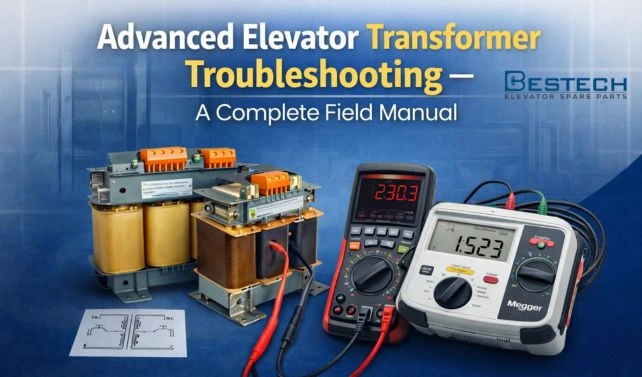
When a lift stops between floors and the controller shows no clear error it can confuse even experienced technicians. The cabin lights may flicker and the system may reset again without warning. In many cases, technicians first suspect the controller board or motor drive. However, the real cause may be the transformer inside the elevator control panel.
This guide explains how elevator transformers work, how to identify lift transformer failure and how technicians can perform effective elevator transformer troubleshooting during maintenance.
How Elevator Transformers Work
An elevator control system cannot run directly on the high voltage coming from the building supply. Most commercial buildings provide three phase power around 380V to 415V. Control boards, safety relays, door controllers and signal circuits require much lower voltage to operate safely.
The transformer inside the lift control panel solves this problem. It converts high voltage supply into stable lower voltage for the control circuit.
Step Down Function
The transformer reduces the incoming high voltage supply to lower control voltages like 110V, 48V or 24V. These lower voltages power important elevator components such as control boards, relays, door controllers and safety circuits.
Electrical Isolation
The transformer separates the high power supply from the control circuit. This isolation protects sensitive control components from electrical disturbances and improves safety during maintenance.
Control Power Stability
The transformer provides stable voltage for elevator control systems. It supports devices such as relays and the elevator switching power supply, helping maintain reliable system operation and preventing elevator power supply issues.
Common Failure Symptoms
A failing transformer usually gives clear warning signs before total failure. Technicians should learn to recognize these symptoms during inspection.
Overheating
Heat is one of the most common signs of lift transformer failure. A transformer that runs hotter than normal may have insulation damage or internal winding problems.
Overheating may also happen when another device connected to the transformer draws excess current.
Voltage Drop
Voltage drop happens when the transformer cannot maintain the rated output voltage under load. For example, a transformer rated at 110V may drop to 90V when the controller starts.
This voltage instability can cause the lift controller to restart or show communication errors.
Buzzing or Humming Sound
Transformers naturally produce a light humming sound due to magnetic vibration inside the core. However loud buzzing or vibration usually indicates loose laminations or internal coil problems.
A loud sound should always be investigated during elevator transformer troubleshooting.
Burning Smell
A burning smell from the panel is a serious warning. This may indicate insulation breakdown inside the transformer windings. Immediate inspection is required because the transformer may fail completely.
Random Lift Shutdown
When the transformer output becomes unstable the controller may shut down without clear fault messages. Many technicians initially suspect the controller board but the real cause may be the transformer.
Step by Step Voltage Testing Procedure
Technicians can follow a structured transformer testing procedure lift to identify faults quickly.
Step 1: Verify Main Power Supply
Measure the incoming power at the transformer primary terminals using a multimeter. The supply should normally read 380V to 415V AC between phases.
Check protection devices such as elevator circuit breaker 4P 63A if the voltage is missing or unstable. A tripped breaker or loose connection can interrupt the power supply and appear like a transformer fault.
Step 2: Confirm Phase Order
Incorrect phase sequence can lead to electrical problems in the elevator control system. It may cause the system to behave abnormally or prevent certain components from operating correctly.
Use an elevator phase sequence relay to check the phase rotation of the incoming supply. The wiring should be corrected before continuing with further tests if the relay indicates an incorrect phase order.
Step 3: Measure Transformer Secondary Voltage
Measure the output voltage at the transformer secondary terminals using a multimeter.
Typical elevator control voltages include:
- 110V AC for contactors and relays
- 48V AC for control circuits
- 24V AC for sensors and logic devices
The reading should be close to the rated value. A much lower voltage may indicate lift transformer failure.
Step 4: Test Under Load
A transformer may show correct voltage when idle but drop voltage when the control circuit draws power. Reconnect the controller and measure the secondary voltage while the panel is active. A significant drop may indicate lift transformer failure or overload from another component.
Step 5: Inspect Connected Components
Components connected to the transformer should also be checked. A faulty device can overload the transformer and create similar symptoms.
Inspect parts such as the elevator contactor AC110V and control relays. A damaged contactor coil may draw excess current which can cause transformer overheating or unstable voltage.
Multimeter Reading Reference Values
Multimeter readings help technicians quickly check whether the transformer is working within the normal range during elevator transformer troubleshooting.
Primary Voltage
Measure the input supply at the transformer primary terminals. The reading should be around 380V to 415V AC between phases in most installations. A lower value may indicate a building power supply problem.
Secondary Voltage
The output voltage depends on the transformer rating. Common examples include:
- 110V transformer: about 105V to 115V
- 48V transformer: about 45V to 50V
- 24V transformer: about 22V to 26V
If the reading is far from the rated value, it may indicate internal winding damage or overload.
Resistance Test
The power supply technicians can measure coil resistance after isolating. Infinite resistance usually means an open winding while very low resistance may indicate a shorted coil.
When to Repair vs Replace
Once the fault is confirmed, technicians must decide whether the transformer can be repaired or must be replaced.
Situations Where Repair May Be Possible:
- Loose wiring connections at the terminals
- Dust buildup causing poor cooling
- Loose mounting bolts causing vibration noise
Cleaning the panel tightening terminals and restoring proper ventilation may solve these problems.
Situations Where Replacement Is Required:
- Burned insulation inside the transformer coil
- Output voltage instability even with no load
- Visible overheating damage or melted insulation
In such cases, replacement is the safest option. Using reliable components from a trusted elevator spare parts supplier ensures system reliability and long service life..
Safety Precautions During Transformer Testing
Working inside elevator control panels exposes technicians to dangerous voltage. Strict safety practices must be followed.
- Switch off the main power before opening the control panel.
- Use insulated tools during measurement.
- Wear protective gloves and safety shoes.
- Confirm the circuit is isolated before touching terminals.
- Never touch exposed conductors with bare hands.
- Check whether the protection devices are functioning correctly.
Safe working practices protect technicians and prevent further damage to the lift system.
Final Thoughts
Power related elevator faults can take time to diagnose if the root cause is not checked early. In many cases the issue is linked to transformer faults rather than the controller.
By following a proper transformer testing procedure lift and checking devices like the elevator phase sequence relay, elevator contactor AC110V and elevator switching power supply, technicians can identify the real cause of an elevator power supply issue and restore reliable lift operation.
FAQ
1. What causes lift transformer failure?
Common causes include overheating, overload, loose wiring, insulation damage and poor ventilation in the control panel.
2. How do I confirm an elevator transformer problem?
Measure the input and output voltage with a multimeter. If the input is normal but the output is low, the transformer may be faulty.
3. Can a contactor create transformer problems?
Yes. A faulty elevator contactor AC110V coil can draw excess current and cause voltage drop or overheating.
4. Why is a phase sequence relay important in lifts?
An elevator phase sequence relay checks the correct phase order in three phase supply and helps prevent system faults.
5. Where can technicians buy reliable elevator electrical parts?
Technicians can purchase parts from a trusted elevator spare parts supplier like Bestech.